
Objectives
- empowerment of our trainers, by building mindfulness, resilience and promoting well-being
- improving the ability to include people with particularities
- sustainability of knowledge
- improvement of our organization at the level of modernization in its operation
- digital and ecological upgrading through contacts with European organizations
- extroversion
- promotion of European programs
At skill level:
- empowerment – strengthening of skills (mindfulness-resilience) and well-being In terms of knowledge
- development of a corpus of practices in nature for the development of skills
- improvement of the ability to create mobilities of high quality
At the level of attitudes/behaviors:
- increasing trainers’ capacity to respond to people with particularities
- promoting sustainability
- promoting European consciousness
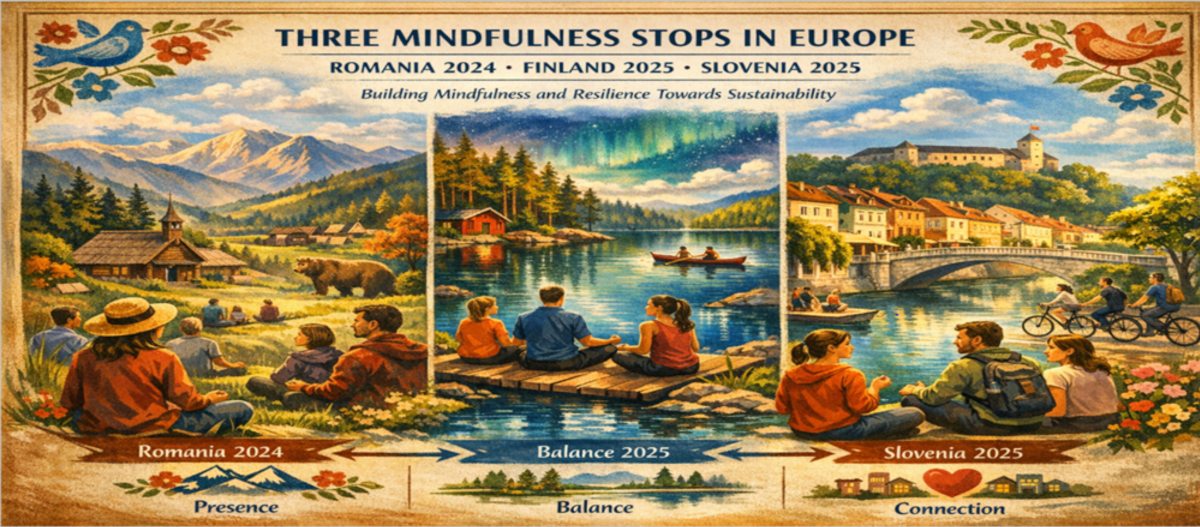
Erasmus KA122 Mobilities: ‘Building Mindfulness and Resilience Towards Sustainability’
In a world shaped by rapid change, digital overload, and increasing emotional demands on both students and teachers, the Erasmus KA1 project “Building Mindfulness and Resilience Towards Sustainability” set out to explore how European educational cultures cultivate presence, balance, and inner strength. Between 2024 and 2025, three distinct destinations — Romania, Finland, and Slovenia — became powerful mindfulness stops, each offering its own lessons on how educators can nurture sustainable well‑being in themselves and their school communities.
Romania 2024 — Mindfulness in the Land of Forests, Traditions, and Quiet Strength
The journey began in Romania, a country where nature, history, and cultural resilience coexist in a delicate, grounding harmony. Educators from Greece stepped into a landscape shaped by the Carpathian Mountains, vast forests, and villages where time slows down and presence becomes a natural state of being. Romania became a living classroom for exploring mindfulness as a practice of self‑awareness, emotional grounding, and sustainable living.
The country’s landscapes — from the serene hills of Transylvania to the quiet flow of the Danube — offered a powerful metaphor for inner balance. Romanian culture carries a deep respect for nature and tradition, reminding participants that resilience is often built through simplicity, connection, and continuity.
Forest paths encouraged educators to slow their pace, breathe deeply, and reconnect with the grounding rhythm of the natural world. Through breathing exercises, guided reflection, and silent observation, participants practiced stepping out of the “automatic pilot” that dominates modern life.
Romania also highlighted the importance of well‑being as a form of sustainability. In rural communities, people cultivate a mindful relationship with the land — taking only what is needed, valuing seasonal rhythms, and embracing a lifestyle that balances effort with rest. This approach mirrors the essence of mindful teaching: caring for one’s inner landscape in order to support others with clarity and compassion.
Finally, the exploration of character strengths became a central theme. Just as the Carpathian forests endure storms and seasons through deep roots and quiet resilience, individuals thrive when they recognize and cultivate their inner resources. This awareness is a cornerstone of mindful living and mindful education.
Finland 2025 — The Pedagogy of Calm and Sustainable Well‑Being
The second mobility took place in Finland, a country internationally admired for its educational philosophy rooted in trust, balance, and emotional well‑being. Here, mindfulness is not an isolated practice but a cultural rhythm woven into everyday life — a natural extension of Finland’s commitment to sustainable education.
Finnish classrooms embody a pedagogy of calm: unhurried lessons, gentle transitions, and learning environments that prioritize emotional safety. Silence is not an absence but a tool — a space where thinking can breathe. Teachers model presence through their tone, posture, and interactions, showing that learning flourishes when pressure is replaced by trust.
Nature plays a central role. Forest walks, lakeside reflections, and outdoor learning sessions offered educators a chance to experience outdoor mindfulness, reconnecting with the grounding power of the natural world. Practices such as emotion check‑ins, slow breathing routines, and mindful movement demonstrated how small rituals can transform the school day.
Finland revealed that mindfulness is not an “extra activity” but a way of being — a gentle, steady commitment to noticing, listening, and responding with intention. This approach aligns deeply with the Erasmus project’s goal of building resilience and sustainable well‑being in school communities.
Slovenia 2025 — Mindfulness as Community and Urban Sustainability
The final stop, Slovenia, added a new dimension: mindfulness as a collective experience. The Slovenian capital, known for its green philosophy, pedestrian‑friendly streets, and human‑centered design, offered a living example of how a country can cultivate presence, connection, and sustainable living.
Here, mindfulness expanded beyond the individual to include community, empathy, and cultural coexistence. Workshops focused on collaborative learning, restorative communication, and social awareness, showing how mindful practices can strengthen relationships and create inclusive school cultures.
Slovenia’s gentle urban rhythm — bicycles gliding along rivers, quiet public squares, and spaces designed for conversation — encouraged educators to slow down and observe how environments shape behaviour. The country became a reminder that mindfulness is not only about inner stillness but also about building communities where every voice feels heard and every person feels they belong.
A Journey That Continues
Across these three European stops, the Erasmus KA1 project “Building Mindfulness and Resilience Towards Sustainability” revealed mindfulness as a multifaceted practice:
- presence in Romania,
- balance in Finland,
- connection in Slovenia.
Together, they formed a powerful trilogy of learning, reminding educators that teaching is not only the transmission of knowledge but also the cultivation of awareness, resilience, and humanity. In a world that moves fast, mindfulness invites us to pause, breathe, and rediscover what truly matters — in the classroom and beyond.